

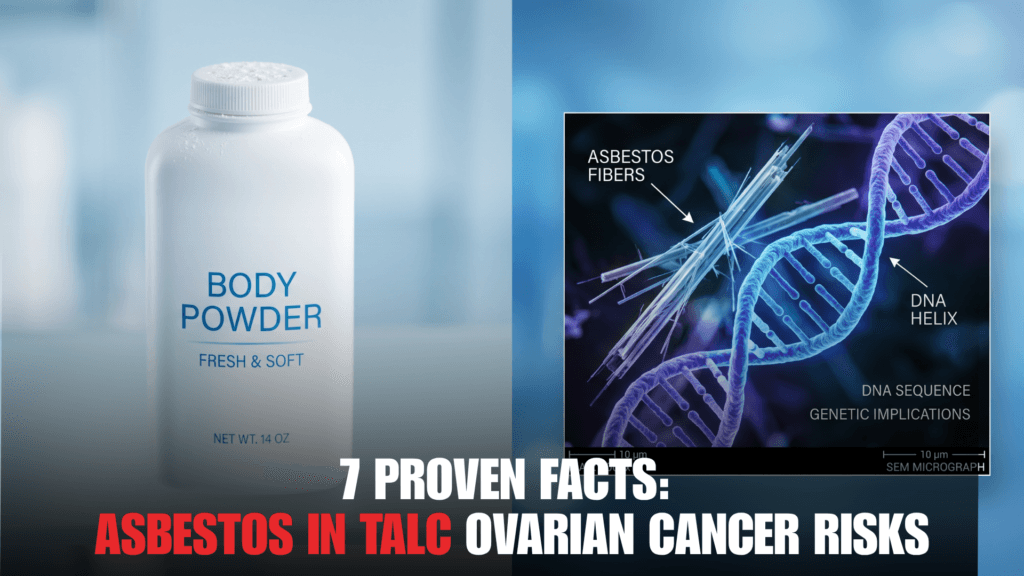
The connection regarding asbestos in talc ovarian cancer risks is a growing legal and medical concern. For decades, many women used talcum powder daily without knowing the potential dangers. We understand how confusing this may feel, especially when your health is at stake.
Table of Contents
Understanding the Geology of Talc and Asbestos
Talc is a mineral mined from the earth. However, it often develops naturally alongside asbestos. Therefore, the mining process can lead to cross-contamination. When manufacturers do not test rigorously, tainted products reach consumers.
Research indicates that even trace amounts of asbestos are dangerous. In addition, these fibers are known carcinogens. Consequently, when contaminated talc is used for feminine hygiene, the fibers can migrate.
How Asbestos in Talc Ovarian Cancer Links Occur
Scientists have studied how fibers reach the ovaries. First, particles move through the reproductive tract. Then, they cause chronic inflammation in the ovarian tissue. This persistent irritation often leads to DNA damage. As a result, cancerous cells may begin to grow over time.
Key Factors in Talc Litigation:
- Duration of Use: Long-term daily use increases exposure.
- Product Type: Specifically body powders and cosmetic products.
- Contamination Levels: The presence of tremolite or anthophyllite asbestos.
7 Vital Statistics on Talc Safety
Statistics show the gravity of this health crisis. According to a 2020 report, nearly 33,000 women face ovarian cancer diagnoses annually. Furthermore, studies found asbestos fibers in ovarian tissue samples of regular talc users.
Legal Fact: The statute of limitations for filing a claim varies by state. However, it typically begins from the date of your diagnosis. Therefore, acting quickly is essential for your case.
Legal Precedents and Court Findings
Courts have reviewed thousands of internal corporate documents. For example, some records suggest companies knew about asbestos in talc ovarian cancer risks decades ago. They failed to warn the public properly. Because of this negligence, juries have awarded billions in damages.
Steps to Take After a Diagnosis
If you suspect a link between your illness and talc, seek help. First, gather your medical records. Second, document your history of product use. In addition, consult with a legal expert specializing in mass tort
DID YOU KNOW?
Conclusion
The link involving asbestos in talc ovarian cancer is supported by significant evidence. Protective measures were ignored for far too long. If you are suffering, you deserve answers and justice today.
EXTERNAL SOURCES
- FDA Official Talc Report: U.S. Food and Drug Administration
- Ovarian Cancer Research Data: National Cancer Institute (.gov)
- Carcinogen Classification: International Agency for Research on Cancer (IARC)
“Johnson & Johnson knew about the asbestos in their talc for decades. Your medical bills and suffering deserve justice — not more silence.”
— Visit MassTortTraffic.com or Call (+1) 210-940-9440
Frequently Asked Questions About Talcum Powder Lawsuits
These lawsuits allege that Johnson & Johnson and other manufacturers knew for decades that their talc-based products (like Baby Powder and Shower to Shower) were contaminated with asbestos, a known carcinogen. Despite this knowledge, they failed to warn consumers, leading to thousands of women developing ovarian cancer and mesothelioma.
Asbestos-contaminated talcum powder has been linked to two primary cancers: ovarian cancer (from long-term perineal/feminine hygiene use) and mesothelioma (from inhaling asbestos fibers in talc). Some studies also suggest a possible link to endometrial and fallopian tube cancers.
The primary products include Johnson’s Baby Powder (talc-based version) and Shower to Shower. Lawsuits have also been filed against other talc suppliers and cosmetic companies, including Colgate-Palmolive and Imerys Talc America.
Scientific evidence shows that talc particles applied to the genital area can travel upward through the reproductive tract, reaching the ovaries and fallopian tubes. These particles cause chronic inflammation, which over years or decades can lead to the development of cancerous cells.
Internal company documents unsealed in court revealed that Johnson & Johnson executives and scientists knew their talc tested positive for asbestos since the 1970s. They hid this evidence from regulators and the public for decades while continuing to market the product as safe.
No. These cases are not a class action. They are a “mass tort,” meaning each plaintiff’s case is evaluated individually, and compensation is based on the specific harm each person suffered (diagnosis date, severity, medical expenses, etc.).
Johnson & Johnson has proposed a $6.5 billion global settlement to resolve over 60,000 ovarian cancer claims. A bankruptcy court is overseeing the voting process, with a confirmation hearing scheduled for early 2026. Mesothelioma cases continue separately with ongoing trials.
Women who used Johnson’s Baby Powder or Shower to Shower for feminine hygiene for a prolonged period (typically years) and were later diagnosed with ovarian cancer may be eligible. Additionally, anyone diagnosed with mesothelioma after using talc-based products may have a claim.
Key evidence includes medical records confirming cancer diagnosis (ovarian or mesothelioma), proof of long-term talcum powder use (receipts, photos, witness statements), pathology reports, and treatment records showing surgeries, chemotherapy, or radiation.
The statute of limitations varies by state, typically ranging from 1 to 4 years from the date of diagnosis or discovery of the link between talc and cancer. Many states use the “discovery rule,” which can extend the filing deadline. Do not delay — consult an attorney immediately.
Yes. Families of individuals who died from ovarian cancer or mesothelioma after talcum powder use can file wrongful death claims to recover funeral expenses, lost income, loss of companionship, and emotional suffering.
Victims may recover compensation for medical expenses (surgery, chemotherapy, radiation, hospice care), lost wages, pain and suffering, emotional distress, loss of consortium, and in some cases, punitive damages to punish the manufacturer.
Results vary widely based on individual circumstances. Past verdicts have ranged from millions to billions: a $2.2 billion verdict in 2024, $417 million in 2017, and $72 million in 2016. Settlements under the proposed $6.5 billion fund will vary based on cancer type, severity, and length of use.
Most talcum powder attorneys work on contingency, meaning you pay nothing upfront. They only get paid if you receive compensation, typically taking a percentage (around 33-40%) of the final settlement or verdict.
Most cases are resolved through settlements, especially with the proposed $6.5 billion global settlement. However, some cases — particularly mesothelioma claims — may still go to trial if a fair settlement cannot be reached.
In 2020, Johnson & Johnson announced it would stop selling its talc-based baby powder in the United States and Canada, switching to a cornstarch-based formula. However, the company cited “declining demand” and litigation pressures, not safety concerns.
In 2019, the FDA released test results showing asbestos contamination in a sample of Johnson’s Baby Powder, leading to a voluntary recall. The agency has since urged cosmetic companies to test their talc supplies for asbestos regularly.
The International Agency for Research on Cancer (IARC) classifies perineal use of talc-based body powder as “possibly carcinogenic to humans” (Group 2B). Asbestos-contaminated talc is classified as “carcinogenic to humans” (Group 1). The American Cancer Society acknowledges the link.
Mesothelioma has a very poor prognosis, with a median survival time of 12 to 21 months after diagnosis. The 5-year survival rate is approximately 10%, making early compensation critical for affected families.
Yes. While Johnson & Johnson is the primary defendant, lawsuits have also been filed against other talc suppliers and store-brand manufacturers. An attorney can help determine all potentially responsible parties.
Even if your diagnosis was years ago, you may still be able to file a claim. The “discovery rule” in many states means the statute of limitations clock starts when you learned (or reasonably should have learned) that talcum powder may have caused your cancer — not necessarily the diagnosis date.
As of late 2025, there are over 60,000 pending talcum powder lawsuits against Johnson & Johnson, making it one of the largest mass tort litigations in U.S. history.
Johnson & Johnson argues that decades of studies show no causal link between talc and ovarian cancer. They also claim their talc is asbestos-free and that their products are safe. However, juries and unsealed documents have repeatedly contradicted these claims.
Yes. You can file a claim whether you are currently in treatment, in remission, or have completed treatment. The key factor is having a confirmed diagnosis of ovarian cancer or mesothelioma after talcum powder use.
Johnson & Johnson has proposed a $6.5 billion global settlement to resolve nearly all pending and future ovarian cancer claims. The settlement would create a trust fund for victims, with payouts based on diagnosis, severity, and length of talc use. A bankruptcy court confirmation hearing is scheduled for early 2026.
No. Mesothelioma cases are generally not part of the global settlement and continue to proceed separately. These cases often result in major verdicts, including recent $100+ million jury awards against Johnson & Johnson.
Joining the litigation helps secure compensation for medical bills, lost income, and suffering. It also holds manufacturers accountable for decades of deception and drives industry-wide safety changes.
Through law firms experienced in talcum powder mass tort litigation. Evaluations are typically free, confidential, and no-obligation. Visit MassTortTraffic.com or call (+1) 210-940-9440 for a free consultation.
Disclaimer: This content is for informational purposes only and does not constitute legal advice. The “talcum powder lawsuit update” reflects current public news and should not be used to determine legal eligibility. Consult with a licensed attorney for specific legal guidance regarding your case.