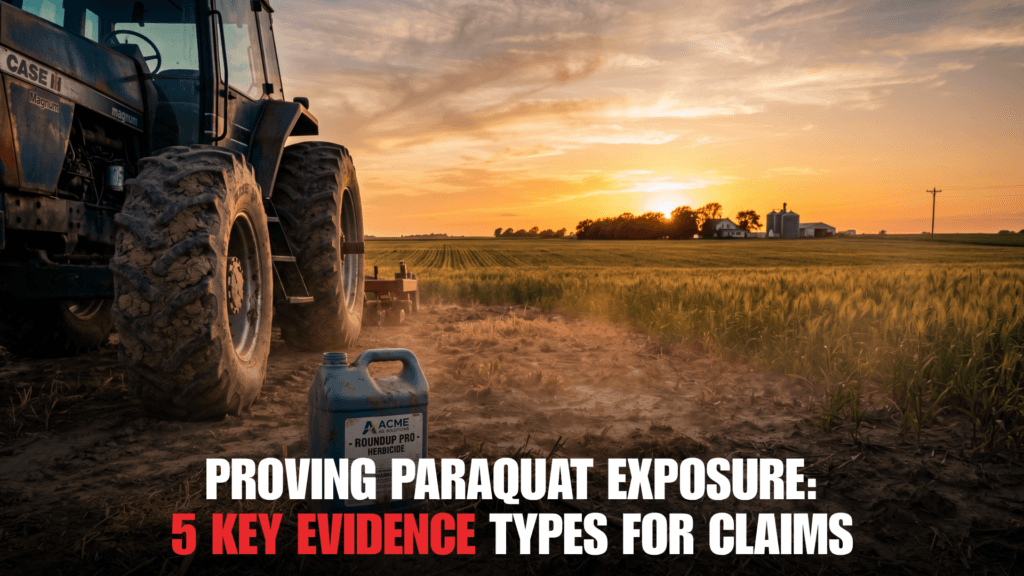
Proving Paraquat Exposure: 5 Key Evidence Types for Claims
masstorttraffic
April 23, 2026
If you worked in agriculture and now face a Parkinson’s diagnosis, you are likely overwhelmed. However, proving paraquat exposure is the vital bridge between your illness and the compensation you deserve to manage your future.
Paraquat Parkinson’s Lawsuit Information
Key Takeaways: The Paraquat Parkinson’s Lawsuit
◆The Legal Claim: Failure to Warn. Lawsuits filed against manufacturers like Syngenta and Chevron allege the companies knew for decades that Paraquat was neurotoxic and linked to Parkinson’s disease, but they failed to adequately warn users and regulators, prioritizing profits over the safety of farmers and agricultural workers.
◆Who is Affected: This is a health crisis impacting farming communities. Paraquat is a “Restricted Use Pesticide,” meaning it is primarily handled by licensed applicators, including farmers, farmworkers, herbicide mixers/loaders, and crop dusters. Thousands of these workers, who were repeatedly exposed, have now been diagnosed with Parkinson’s disease.
◆Your Family’s Rights: If you or a loved one was exposed to Paraquat (even decades ago) and later received a Parkinson’s disease diagnosis, your family may be eligible to file a lawsuit. A successful claim can secure vital compensation for medical bills, future care costs, lost income, and the immense suffering caused by this incurable disease.
◆Most Recent Updates (October 2025):
Federal MDL in Progress: Thousands of federal lawsuits are consolidated in MDL No. 3004 in the Southern District of Illinois. This consolidates all federal cases before one judge to streamline the pre-trial process.
Bellwether Trials Scheduled: The court has selected a group of “bellwether” cases (test trials) that are set to begin in 2026. The outcomes of these first few trials will be critical in shaping potential global settlement negotiations for all cases.
Scientific Evidence Mounts: The court is analyzing the admissibility of key scientific experts (known as Daubert hearings). Plaintiffs’ cases are built on a growing body of scientific literature linking Paraquat to the specific cellular damage that causes Parkinson’s disease.
◆Our Firm is Taking Cases: Our law firm is providing free and confidential consultations to agricultural workers and their families nationwide. If you were diagnosed with Parkinson’s after being exposed to Paraquat, we are actively helping victims file claims to seek justice.
Ready to Fight for Your Compensation?
Your Free, Confidential, No-Obligation Case Evaluation is Waiting!
The Critical Link Between Exposure and Parkinson’s
For decades, paraquat was the gold standard for weed control in American farming. Unfortunately, recent studies have shown that those exposed to this toxic herbicide have a significantly higher risk of developing Parkinson’s disease. In addition, the EPA has recently begun a 2026 reassessment of paraquat safety, highlighting the ongoing risks to workers.
To build a successful legal claim, you must demonstrate two things: a confirmed Parkinson’s diagnosis and documented proof that you were exposed to paraquat dichloride.
1. Professional Licenses and Training Records
Because paraquat is a “Restricted Use Pesticide” (RUP), it cannot be purchased by the general public. Therefore, one of the strongest ways of proving paraquat exposure is through your professional credentials.
Pesticide Applicator Licenses: Copies of your state-issued certification.
EPA Training Certificates: Since 2016, the EPA has required specialized training for paraquat handlers every three years.
Continuing Education Units (CEUs): Records showing you attended sessions specifically regarding herbicide application.
2. Employment and Work History
You do not need to remember every specific date, but you must establish a pattern of work. In addition to direct handling, proximity to spraying is also a factor in many claims.
Pay Stubs and W-2s: Documentation from farms, orchards, or commercial landscaping companies.
Job Descriptions: Contracts that outline duties such as mixing, loading, or applying herbicides.
Work Logs: Daily spray records which are often legally required by state agricultural departments.
3. Medical Documentation and Expert Testimony
A legal claim requires more than just a “suspected” link. You need a formal diagnosis from a neurologist. Medical records should detail the onset of symptoms like tremors, bradykinesia (slowed movement), and postural instability. As a result of these symptoms, your medical history becomes the foundation of your “damages”—the financial and physical toll the disease has taken.
Ready to Take the First Step Toward Justice?
Speak with our trusted legal team today. Your Free, Confidential, No-Obligation Case Evaluation is waiting — and it only takes a minute to begin.
By submitting this form, you agree to be contacted by a trusted legal partner for a free case review. This does not create an attorney-client relationship. Confidential and secure.
4. Purchase Receipts and Invoices
If you owned a farm or ran a private contracting business, your financial records are “smoking gun” evidence.
Invoices: Direct receipts from chemical suppliers or agricultural cooperatives.
Storage Records: Inventory lists showing paraquat was kept on your property.
Equipment Maintenance: Records of cleaning sprayers or tanks that contained the chemical.
5. Witness Statements and Physical Evidence
Sometimes, the paper trail is thin, especially for exposure that happened decades ago. In these cases, corroborating testimony is essential.
Co-worker Testimony: Statements from people who worked on the same crew.
Family Statements: Observations from loved ones who remember you coming home with chemicals on your clothing.
Property Deeds: Proximity records showing you lived or worked adjacent to high-spray areas.
Understanding the Statute of Limitations
Every state has a deadline for filing a toxic tort claim. For example, some states require you to file within two years of your diagnosis. We understand how confusing this may feel, but waiting too long can permanently bar you from seeking justice.
Legal Fact: As of 2026, over 6,500 lawsuits are centralized in the Southern District of Illinois MDL, where judges are currently reviewing settlement structures for eligible victims.
Conclusion
Proving paraquat exposure requires a meticulous collection of records, but you don’t have to do it alone. By gathering licenses, work history, and medical records, you take the first step toward holding manufacturers accountable.
Frequently Asked Questions About the Paraquat Parkinson’s Lawsuit
Part I: Understanding the Lawsuit & Health Risks
These are product liability lawsuits alleging that exposure to the herbicide Paraquat significantly increases the risk of developing Parkinson’s disease. The core legal claim is that manufacturers like Syngenta and Chevron knew (or should have known) of this neurotoxic risk for decades and failed to adequately warn users, particularly farmers and licensed applicators.
Paraquat is a highly toxic herbicide used for weed and grass control. It is one of the most widely used herbicides in the U.S., popular for crops like soy, corn, and cotton. Due to its high toxicity (one sip can be fatal), it is a “Restricted Use Pesticide,” meaning it can only be handled by commercially licensed applicators.
This is a key question in the litigation. Paraquat is banned in over 60 countries, including the entire European Union, the United Kingdom, and China, due to its acute toxicity and links to health risks. Despite petitions from environmental and health groups, the U.S. Environmental Protection Agency (EPA) has continued to re-approve its use, though that decision is also being challenged in court.
A large body of scientific research, some dating back decades, has shown a strong correlation. Studies indicate that Paraquat’s chemical structure is similar to toxins known to cause Parkinson’s-like symptoms. It is believed to work by inducing “oxidative stress,” a process that damages and kills dopamine-producing neurons in the brain—the same neurons whose loss is the hallmark of Parkinson’s disease.
The lawsuits claim that manufacturers like Syngenta and Chevron acted with negligence by failing to:
Warn users of the known link between Paraquat and Parkinson’s disease.
Instruct users on proper safety measures (like respirators) to prevent inhalation.
Design a safer product or remove it from the market when the risks became clear.
Conceal or misrepresent scientific data about Paraquat’s neurotoxicity.
Parkinson’s disease is an incurable, progressive neurodegenerative disorder. It primarily affects movement, causing symptoms like tremors, slowed movement (bradykinesia), rigid muscles, impaired posture and balance, and loss of automatic movements. It can also cause non-motor symptoms like cognitive changes, depression, and sleep problems.
The primary theory, supported by numerous studies, is oxidative stress. Paraquat’s chemical structure allows it to enter brain cells and create a continuous cycle of chemical reactions that produce “free radicals.” These unstable molecules damage all parts of the cell, leading to inflammation and death, particularly in the dopamine-producing neurons that are most vulnerable to this type of attack. The loss of these specific neurons is the direct cause of Parkinson’s disease.
MPTP is a toxic contaminant that was discovered in the 1980s when a batch of synthetic heroin caused users to develop severe, permanent, and immediate-onset Parkinson’s disease. Scientists discovered MPTP has a very similar chemical structure to Paraquat. This discovery was a crucial piece of evidence, as it established a clear link between a Paraquat-like chemical and the specific brain damage that causes Parkinson’s.
The manufacturers strongly deny that a causal link exists between Paraquat and Parkinson’s disease. They maintain that their product is safe when used as directed by licensed applicators. Their legal arguments often state that the scientific studies are inconclusive, that other factors cause Parkinson’s, and that they have complied with all EPA regulations regarding labeling and safety.
The most common brand name for Paraquat in the United States is Gramoxone, which is manufactured by Syngenta. Other brand names you might recognize include Parazone, Quick-Quat, Para-Shot, Helmquat, and Firestorm.
Exposure for agricultural workers can occur in several ways, primarily:
Inhalation: Breathing in aerosolized droplets (“spray drift”) while spraying the herbicide or working in a recently sprayed field.
Skin Contact: The chemical getting on the skin, especially through cuts or open wounds, but studies suggest it can also be absorbed through intact skin after prolonged contact.
Ingestion: Accidentally swallowing the chemical, often from it being stored in an unmarked container (like a water bottle), which is almost always fatal.
Part II: Eligibility & The Legal Process
You may be eligible to file a lawsuit if you or a loved one:
Were diagnosed with Parkinson’s disease.
Had significant exposure to Paraquat.
This primarily includes licensed applicators, farmers, agricultural workers, chemical mixers/loaders, and crop dusters. Some cases also involve individuals who lived on or very near farms where Paraquat was frequently sprayed, alleging “pesticide drift” exposure.
That is common in these cases. Parkinson’s disease has a long latency period, meaning it can take 10, 20, or even 30 years after exposure for symptoms to develop. The “statute of limitations” (the deadline to file) is often based on the date of your diagnosis, not the date of your exposure, under a “discovery rule.” An attorney can determine the specific deadline for your state.
Currently, the lawsuits are specifically for individuals who have been diagnosed with Parkinson’s disease. If you were exposed but do not have a diagnosis, you are not eligible to file a claim at this time. However, if you are experiencing symptoms (like tremors, stiffness, or slowed movement), you should see a neurologist for a full evaluation.
No, it is not a class-action lawsuit. The federal cases are consolidated into a Multidistrict Litigation (MDL). An MDL groups similar cases before one judge for pre-trial proceedings (like discovery) to make the process more efficient. However, unlike a class action, each person’s lawsuit remains individual, and any potential settlement is based on the specific facts of their case.
Ready to Fight for Your Compensation?
Your Free, Confidential, No-Obligation Case Evaluation is Waiting!
The Paraquat MDL (MDL No. 3004) is in an active pre-trial phase in the Southern District of Illinois, with thousands of cases pending. The judge is overseeing discovery (the exchange of evidence) and ‘Daubert’ hearings to determine which scientific experts will be allowed to testify. The first ‘bellwether’ (test) trials are scheduled to begin in 2026, and their outcomes will be critical for negotiating a potential global settlement.
A “bellwether trial” is a test case. In an MDL with thousands of plaintiffs, it’s impossible to try every case. The court selects a small, representative group of cases to be tried first. The verdicts in these trials are used to gauge how juries might react to the evidence, which helps both sides value the remaining cases and often leads to a global settlement.
A strong case is built on documentation. Key evidence includes:
Medical Records: Documents confirming your Parkinson’s disease diagnosis.
Exposure Records: Proof of your exposure to Paraquat. This can include your pesticide applicator license, purchase receipts for Paraquat (e.g., Gramoxone), farm records, or employment records.
Witness Testimony: Statements from co-workers, family, or neighbors who can attest to your use of Paraquat or proximity to it.
Don’t worry. This is a common problem, as exposure often happened decades ago. An experienced law firm has investigators who are skilled at gathering evidence. They can work to track down old employment records, co-op purchase histories, and other documents to help establish your exposure.
Yes. The Paraquat litigation is a “Multidistrict Litigation” (MDL), which consolidates all federal cases from across the country before one judge in Illinois. This means you can join the federal litigation regardless of which state you lived or worked in when you were exposed. Your attorney will file your case in the appropriate federal court, and it will then be transferred into the MDL.
While possible, it is unlikely. The vast majority of product liability lawsuits (over 95%) are resolved through a confidential settlement before a trial begins. The “bellwether” trials in the MDL are designed to test arguments and evidence, which often encourages the defendants (Syngenta, Chevron) to negotiate a global settlement for the remaining cases.
It is highly unlikely. The vast majority of mass tort cases are resolved in a global settlement, and most plaintiffs never have to go to court. The only people who typically testify are those selected for the “bellwether” (test) trials. You will likely need to provide a recorded statement or deposition in a lawyer’s office, but your attorney will prepare you for this.
Part III: Compensation and Costs
Compensation, or “damages,” is designed to cover the full extent of the harm caused. It typically falls into two categories:
Economic Damages: Tangible, calculable costs like past and future medical bills, therapy expenses, medication costs, in-home care, and lost wages or future earning capacity.
Non-Economic Damages: Compensation for intangible harms like physical pain, emotional distress, mental anguish, loss of enjoyment of life, and the impact on your family (loss of consortium).
There is no set formula, as each case is individual. The value of a case depends on several factors, including:
The severity of your Parkinson’s symptoms and its progression.
The total cost of your past and estimated future medical care.
The amount of income you lost and will lose in the future.
The strength of your exposure evidence.
Your age at diagnosis.
This is a common issue. Parkinson’s is a complex disease. However, the law in many states allows for recovery even if there are multiple contributing causes. The legal claim is that Paraquat exposure was a “substantial factor” in *causing* or *contributing* to the development of the disease. A skilled attorney can build a case arguing that even with other risk factors, the disease would not have occurred (or would not have been as severe) without the neurotoxic effects of Paraquat.
Yes. If a family member was diagnosed with Parkinson’s after Paraquat exposure and has since passed away, their surviving family members (usually a spouse or children) may be able to file a wrongful death lawsuit or a survival action. These claims seek to recover damages for the suffering the victim endured before death, as well as funeral expenses and the loss of the loved one’s income and companionship. The time limits for these cases are often very strict, so it’s important to speak with an attorney quickly.
If the manufacturers agree to a global settlement, a fund is established. The settlement will have complex criteria for how to allocate the money based on factors like your exposure level, diagnosis severity, and age. Your attorneys will review the settlement with you, and you will have the choice to accept or reject your allocated award. It is not like a class action where you are forced to accept the outcome.
Multidistrict Litigation (MDL) is a long process, often taking several years. The Paraquat MDL is already underway, but it involves extensive scientific discovery and expert battles. While a settlement could happen at any time, it is most likely to occur after the first bellwether trials, which are scheduled for 2026. Patience is key, as a strong, well-developed case is more likely to result in a fair settlement.
There are no upfront or out-of-pocket costs to your family. Attorneys who handle these cases work on a contingency-fee basis, which means they only get paid if they successfully recover money for you through a settlement or verdict. Their fee is a percentage of the final recovery. If you do not win, you owe no attorney fees.
Diagnosed with Parkinson’s After Paraquat Exposure?
Your Free, Confidential, No-Obligation Case Evaluation is Waiting!
Yes. For many families, a lawsuit is also about holding manufacturers accountable. By forcing these companies to face the consequences of their alleged negligence, the litigation brings public awareness to the dangers of Paraquat and pressures them and regulators to enact real, systemic change, potentially preventing future generations from suffering the same harm.
Disclaimer: This article is for informational purposes only and does not constitute legal or medical advice. For professional legal counsel, please consult with a licensed attorney specializing in toxic torts. For medical concerns, consult a qualified healthcare professional.
Meningioma surgery deficits may affect memory, speech, concentration, motor skills, and emotional stability after brain tumor treatment. Many patients experience long-term neurological complications requiring rehabilitation, cognitive therapy, emotional support, and ongoing medical care following complex brain surgery and post-operative neurological recovery. Key Takeaways: Depo-Provera Brain Tumor Lawsuits ◆The Legal Allegation: Increased Meningioma Risk. Lawsuits allege […]
Brain tumor surgery recovery can affect nearly every aspect of daily life after meningioma treatment. Many patients face emotional trauma, neurological symptoms, physical rehabilitation, cognitive complications, and financial stress for months or even years after undergoing major brain surgery and neurological treatment. Key Takeaways: Depo-Provera Brain Tumor Lawsuits ◆The Legal Allegation: Increased Meningioma Risk. Lawsuits […]


 100% Secure & Confidential
|
100% Secure & Confidential
|
 No Obligation Consultation